
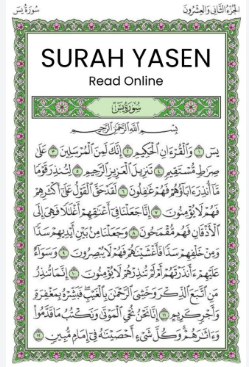
Surah Yaseen is one of the most widely read chapters of the Quran. Many Muslims recite it during personal worship, family gatherings, times of reflection, and moments when they want to listen to the words of Allah. Its verses speak about faith, the mission of the messengers, Allah’s power, human responsibility, death, resurrection, and the life to come.
Surah Yaseen is the 36th chapter of the Quran and contains 83 verses. It is generally classified as a Makkan surah. Its message focuses strongly on the oneness of Allah and the reality of resurrection.
The surah begins with the mysterious letters Ya-Sin and then confirms the truth of the Prophet Muhammad’s mission. It presents a warning to those who reject the truth and gives hope to those who believe. Later verses point to signs in creation, including the earth, plants, night and day, the sun, the moon, ships, and human creation.
One of the most powerful parts of Surah Yaseen is its discussion of resurrection. Some people in the Prophet’s time questioned how human beings could be brought back after their bodies had become dust. The surah answers this doubt by reminding people that the One who created them in the first place has complete power to create them again.
The closing verses give a clear message: Allah has complete control over creation, and every person will return to Him. The final verse states that the dominion of everything belongs to Allah and that people will be returned to Him.
This article looks at Surah Yaseen from several angles. It covers its meaning, structure, major themes, lessons, commonly discussed benefits, and important points about reports attributed to the Prophet Muhammad ﷺ.
What Is Surah Yaseen?
Surah Yaseen is the 36th surah of the Quran. It has 83 verses and is traditionally regarded as a Makkan revelation. Like many Makkan chapters, it focuses on basic matters of faith rather than detailed legal rules.
Its central message can be understood through several connected ideas:
- Belief in one Allah
- Acceptance of divine revelation
- The truth of the Prophet’s message
- The signs of Allah in creation
- Human accountability
- Death and resurrection
- Paradise and punishment
- Allah’s complete power
The surah repeatedly asks people to think about the world around them. Instead of presenting faith as something disconnected from reason, it points to signs that people can see in ordinary life.
Why Is It Called Surah Yaseen?
The chapter is commonly called Surah Yaseen because it opens with the Arabic letters:
يس
These are known as the disconnected or mysterious letters found at the beginning of several Quranic chapters.
The exact meaning intended by these letters is not definitively known. Muslims therefore generally avoid claiming a specific meaning unless it is supported by reliable evidence.
The name “Yaseen” is widely used for the surah in English, Urdu, Arabic, and many other languages.
Surah Yaseen at a Glance
| Feature | Information |
|---|---|
| Surah number | 36 |
| Common name | Surah Yaseen / Ya-Sin |
| Arabic name | يس |
| Number of verses | 83 |
| Juz | 22 and 23 |
| Common classification | Makkan |
| Main subjects | Tawhid, revelation, resurrection, accountability |
| Opening | Ya-Sin |
| Closing theme | Allah’s absolute dominion and return to Him |
The chapter appears toward the later part of the Quran and continues into Juz 23. Its relatively short verses and strong rhythm make it familiar to many people who regularly listen to Quran recitation.
Main Message of Surah Yaseen
The main message of Surah Yaseen is that people should recognize Allah as the only true Lord, accept His guidance, and prepare for the life after death.
The surah does not present these ideas as separate topics. Instead, they are connected.
This connection gives the surah a strong sense of purpose.
Tawhid and the Oneness of Allah
Tawhid, or belief in the oneness of Allah, is central to Surah Yaseen.
The chapter repeatedly points people toward the Creator. It describes signs in the natural world and asks readers to consider what those signs tell them about divine power.
The message is not simply that Allah exists. It is that Allah alone deserves worship and that nothing in creation shares His authority.
Prophethood and Revelation
The opening section addresses the Prophet Muhammad ﷺ and confirms his status as a messenger.
The surah presents the Quran as revelation and emphasizes the importance of following divine guidance.
This was a major issue in Makkah, where the Prophet ﷺ faced rejection from many people who did not accept his message.
Surah Yaseen reminds readers that rejection of a messenger is not a new human behavior. Earlier communities also received warnings and messengers.
The Story of the Messengers in Surah Yaseen
One of the most memorable sections of Surah Yaseen is the account of a town that received messengers.
The Quran does not identify the town by a specific historical name in the passage. It tells the story to teach a moral lesson rather than to provide a detailed historical record.
Two messengers are sent, followed by a third. The people reject them and question their message.
Then a man comes from the farthest part of the city. He urges his people to follow the messengers.
His words show sincere faith and concern for his community.
He explains that there is no reason to worship beings other than the One who created him. His statement reflects one of the central principles of Surah Yaseen: the Creator deserves worship.
The Believing Man
The believing man is an important example of courage.
He does not keep his faith hidden when his community rejects the messengers. Instead, he speaks clearly.
His attitude also shows that sincere belief should affect behavior.
He does not simply argue for the sake of winning a debate. He wants his people to receive guidance.
The passage reminds readers that faith can require courage, patience, and concern for others.
His Reward
After the man is killed, he is told to enter Paradise. His response expresses regret that his people did not know what he had received from his Lord.
This moment is powerful because his concern for his community remains even after their rejection of him.
The story therefore teaches several lessons:
| Lesson | Meaning |
|---|---|
| Faith requires courage | A believer may need to stand for truth despite opposition |
| Guidance is a serious matter | People should not treat divine guidance casually |
| Good intentions matter | The man wanted good for his community |
| Allah rewards faith | His final reward was Paradise |
| Rejection has consequences | The community ignored repeated warnings |
Signs of Allah in Creation
After the story of the messengers, Surah Yaseen directs attention toward signs in creation.
This section is one of the most important parts of the surah because it encourages people to think.
The Dead Earth
The surah points to dead land that Allah brings to life through vegetation.
A dry piece of land may appear lifeless, yet rain can cause plants to grow.
This visible process becomes a reminder of resurrection.
If Allah can bring life to apparently dead land, the idea of bringing people back to life should not be considered impossible.
Gardens and Crops
The surah refers to gardens, date palms, grapes, springs, and crops.
These things provide food and benefit to human beings.
The lesson is that people should recognize the source of these blessings rather than taking them for granted.
Night and Day
The changing of night and day is another sign.
People live according to this pattern every day, so it can easily become something they stop noticing.
Surah Yaseen encourages readers to see ordinary events with greater awareness.
The regular movement from light to darkness and darkness to light points to an ordered creation.
The Sun and Moon
The surah also refers to the sun and moon.
Their movement takes place according to an order established by Allah.
The Quran presents this order as evidence of divine power rather than as random chaos.
This theme is repeated throughout the Quran: creation can serve as a reminder of the Creator when people stop and reflect.
Surah Yaseen and the Reality of Resurrection
Resurrection is one of the strongest themes in Surah Yaseen.
The Quran describes people who question how human beings can be brought back after their bodies have decayed.
The response is direct.
Allah knows how human beings were created in the first place. Therefore, restoring them is not beyond His power.
The Example of the Bone
A famous passage describes a person who brings a decayed bone and asks who can bring it back to life.
The Quran answers that the One who created it in the first place can restore it.
This argument is simple but powerful.
Human beings often judge possibilities according to their own limited abilities. If a person cannot bring a dead body back to life, that does not mean the Creator cannot do so.
The Quran shifts the focus from human limitation to divine power.
Why Resurrection Matters
Belief in resurrection changes the way a person views life.
If there is no accountability after death, people may think that their actions have no lasting consequence.
But if everyone will return to Allah, then choices matter.
Kindness matters.
Justice matters.
Honesty matters.
Worship matters.
Wrongdoing matters.
Surah Yaseen therefore connects belief in the afterlife with moral responsibility.
The Final Verses of Surah Yaseen
The final part of the surah returns to the subject of creation and resurrection.
It asks readers to consider how Allah creates fire from a green tree and reminds them that the Creator of the heavens and earth has the ability to create again.
The final verses contain a very strong statement about Allah’s command.
When He wills something, His command is simply “Be,” and it is. The final verse declares that Allah has control over the realm of everything and that all people will return to Him.
These verses leave the reader with two major ideas:
- Allah’s power is unlimited.
- Every human being will return to Allah.
That combination creates both hope and accountability.
Major Themes of Surah Yaseen
Surah Yaseen contains many lessons, but several themes appear again and again.
| Theme | What Surah Yaseen Teaches |
|---|---|
| Tawhid | Allah alone deserves worship |
| Prophethood | Divine messengers bring guidance |
| Quran | Revelation should be taken seriously |
| Creation | The universe contains signs of Allah’s power |
| Gratitude | Human beings should recognize divine blessings |
| Resurrection | Allah can recreate people after death |
| Accountability | Human actions have consequences |
| Paradise | Faithful people receive a good final outcome |
| Warning | Rejecting truth has serious consequences |
| Divine power | Nothing is beyond Allah’s ability |
Lessons From Surah Yaseen for Daily Life
Surah Yaseen is not only a chapter to recite. Its teachings can also shape daily behavior.
Think About Allah’s Signs
Modern life can make people busy and distracted.
The surah encourages a different habit: pause and think.
A sunrise, rainfall, growing plant, changing night, or human life itself can become a reminder of Allah.
Take Faith Seriously
The story of the messengers shows that faith is not merely a label.
The believing man acted on what he believed.
For a Muslim, faith should influence speech, decisions, relationships, work, and treatment of others.
Remember the Afterlife
Many worries become smaller when a person remembers that this life is temporary.
Surah Yaseen repeatedly turns attention toward resurrection.
This can help a believer keep worldly problems in perspective while still dealing with them responsibly.
Be Concerned About Others
The believing man cared about his people even when they rejected him.
This teaches an important lesson about sincere advice.
A believer should want good for others rather than simply wanting to prove that he or she is right.
Recognize Allah’s Blessings
Food, water, crops, transport, family, health, knowledge, and countless other blessings can easily become ordinary.
Surah Yaseen teaches readers to notice the source of these blessings.
Gratitude can change the way a person views everyday life.
Is Surah Yaseen Called the Heart of the Quran?
Many Muslims have heard the statement that Surah Yaseen is the heart of the Quran.
The phrase is very popular, but it is important to distinguish popularity from hadith authenticity.
A report attributed to the Prophet Muhammad ﷺ says that everything has a heart and that the heart of the Quran is Yaseen, with a special reward for reciting it. Hadith specialists have regarded this report as weak, and some have classified it as fabricated.
Therefore, it is safer to say:
Surah Yaseen is a great and important surah of the Quran, but the specific claim that the Prophet ﷺ authentically called it the “heart of the Quran” is not established by a sound hadith.
This distinction matters because Muslims should avoid attributing unsupported statements to the Prophet ﷺ.
What Are the Benefits of Reading Surah Yaseen?
Reading any part of the Quran is an act of worship and an opportunity for reflection.
Surah Yaseen contains powerful reminders about Allah, revelation, death, resurrection, and accountability.
However, many specific claims about special rewards for Surah Yaseen are based on reports that scholars have judged weak or fabricated.
For example, claims that reading Surah Yaseen automatically brings a particular worldly result, guarantees the fulfillment of a specific need, or produces a fixed reward are not all supported by authentic evidence.
Islamic Q&A sources reviewing the available reports state that no sound hadith has been established specifically concerning a special virtue of Surah Yaseen.
General Benefits of Quran Recitation
Although specific claims should be checked carefully, the general value of Quran recitation is clear within Islam.
Reading Surah Yaseen can help a person:
- Remember Allah
- Reflect on the Quran
- Think about death and resurrection
- Strengthen awareness of divine power
- Learn lessons from earlier communities
- Develop gratitude
- Spend time in worship
- Reflect on personal actions
These benefits come from engaging with the Quran itself rather than relying on unsupported promises.
Surah Yaseen for Fulfillment of Needs
A common statement says:
“Yaseen is for whatever it is read for.”
This phrase is sometimes repeated when people recommend Surah Yaseen for a particular need.
However, this statement should not be presented as an authentic hadith of the Prophet Muhammad ﷺ.
A detailed scholarly response states that this wording has no reliable basis as a prophetic report.
A Muslim can certainly make dua and recite Quran while asking Allah for help. But it is better to avoid claiming that a particular surah guarantees a particular worldly result unless there is reliable evidence for that claim.
Can Surah Yaseen Be Read for a Sick Person?
Reciting Quran for a sick person is generally regarded as a good act of worship, and Muslims may make dua for healing.
However, there is a specific debate over singling out Surah Yaseen for a dying person.
A report commonly translated as “Recite Yaseen for your dying ones” has been judged weak by some scholars, while other scholars have considered it acceptable. Because of this difference, the matter should be presented carefully rather than as an undisputed Sunnah.
The important point is that Quran recitation and dua can be meaningful acts, but claims about a special prescribed use of Surah Yaseen should be supported by reliable evidence.
Surah Yaseen and Funeral Practices
Surah Yaseen is sometimes recited in gatherings connected with a person’s death.
Islamic scholarship differs on certain practices involving Quran recitation for the dying or deceased. Some scholars permit or recommend recitation in certain circumstances, while others do not regard specifically reciting Yaseen for the deceased as established Sunnah because of the weakness of the relevant reports.
This is an area where Muslims may benefit from following a trusted local scholar who understands the relevant school of Islamic law and the evidence behind different positions.
What should be avoided is presenting a disputed practice as something that all scholars agree was commanded by the Prophet ﷺ.
Common Claims About Surah Yaseen: What Is Reliable?
Because Surah Yaseen is so popular, many statements about its special benefits circulate online and in communities.
Some are accurate descriptions of its themes. Others are based on weak reports.
| Common Claim | Evidence Status | Better Way to Present It |
|---|---|---|
| Surah Yaseen has 83 verses | Established Quranic information | State it as a fact |
| It is a Makkan surah | Traditional classification | State it as the standard scholarly classification |
| It teaches Tawhid and resurrection | Clear from the surah | State it confidently |
| It is called the heart of the Quran in an authentic hadith | Not established | Avoid presenting it as authentic |
| Reading it guarantees fulfillment of every need | No sound basis for this claim | Do not present it as a promise |
| Reading it has the general value of Quran recitation | Sound general principle | Encourage reflection and worship |
| A fixed special reward is guaranteed for every recitation | Specific reports are not soundly established | Avoid unsupported reward claims |
| It should always be recited for the deceased | Not established as an undisputed Sunnah | Explain the scholarly disagreement |
How to Read Surah Yaseen With Reflection
A useful way to read Surah Yaseen is to slow down and consider its message.
Read the Arabic
If you can read Arabic, recite the original Quranic text carefully.
Correct pronunciation matters, and learning from a qualified teacher can help improve recitation.
Read a Reliable Translation
If Arabic is not your first language, read a trustworthy English translation alongside the Arabic.
A translation helps you understand the general meaning, although it cannot fully reproduce every feature of the original Arabic.
Read Tafsir
Tafsir provides context and explanation.
Classical works such as Tafsir Ibn Kathir can help readers understand the verses within a broader Quranic framework. Quran.com also provides Quran text and access to tafsir resources.
Pause at the Questions
Surah Yaseen repeatedly encourages thought.
Ask yourself:
- What does this verse teach me about Allah?
- What does it say about human responsibility?
- What does it teach about death?
- How should this affect my behavior?
- What blessing from Allah am I overlooking?
- What change should I make after reading this passage?
This approach turns recitation into a time of learning and reflection.
Surah Yaseen and the Modern Reader
The message of Surah Yaseen remains relevant because its central questions are human questions.
People still ask:
Where did we come from?
Why are we here?
What happens after death?
Does life have a purpose?
How should we respond to divine guidance?
What happens when people reject moral truth?
Surah Yaseen addresses these questions through revelation and reminders from the world around us.
Modern technology has changed how people live, but it has not removed questions about purpose, mortality, morality, or accountability.
A person can read Surah Yaseen on a phone, listen to a reciter online, study a translation, or attend a traditional lesson. The method may change, but the central message remains the same.
Why Surah Yaseen Is So Familiar to Muslims
Several factors help explain the popularity of Surah Yaseen.
Its verses are powerful and memorable. Its subjects include some of the most important themes in Islam. Many famous reciters have recorded it, making it easy for people around the world to hear.
It is also commonly taught to Muslims who are learning Quran recitation.
Most importantly, the surah speaks directly about matters that concern every human being: life, death, faith, rejection, hope, judgment, and return to Allah.
Surah Yaseen and Personal Reflection
A person does not need to wait for a particular day or event to read Surah Yaseen.
It can be read as part of regular Quran study.
A simple routine might include:
- Reading a portion slowly.
- Reading the translation.
- Checking a reliable tafsir.
- Writing down one lesson.
- Thinking about how to apply that lesson.
- Making dua to Allah for guidance.
The goal is not simply to finish the chapter quickly.
The goal is to understand and respond to its message.
Important Points About Quran and Hadith Sources
When reading material about Surah Yaseen online, readers should be careful.
Internet articles often repeat statements without checking their sources.
A strong Islamic article should separate three things:
The Quran itself: What does the surah actually say?
Authentic Sunnah: What has been reliably reported from the Prophet ﷺ?
Later statements: What have scholars or communities said about the surah?
These categories should not be mixed.
For example, the Quran clearly contains the themes of resurrection, divine power, revelation, and accountability. But a claim about a particular reward requires separate evidence.
This distinction is important for responsible religious writing.
Frequently Mentioned Benefits vs. Quranic Lessons
It is useful to separate spiritual reflection from guaranteed claims.
A person may find that reading Surah Yaseen gives them peace, helps them focus, reminds them of death, or strengthens their desire to worship Allah.
These personal experiences can be meaningful.
But an individual’s experience should not automatically become a religious rule or a prophetic promise.
The scholarly discussion of Surah Yaseen’s virtues shows why source checking matters. Many reports about special rewards have been judged weak or fabricated.
A Simple Study Plan for Surah Yaseen
| Study Stage | What to Do | Purpose |
|---|---|---|
| First reading | Read or listen to the full surah | Understand its overall flow |
| Second reading | Read with translation | Understand the meaning |
| Theme study | Mark verses about Allah, messengers and resurrection | See repeated ideas |
| Tafsir study | Consult a reliable tafsir | Gain context |
| Reflection | Write personal lessons | Connect faith to daily life |
| Action | Choose one lesson to practice | Turn learning into behavior |
This method can be used by beginners as well as people who have studied the Quran for years.
What Surah Yaseen Teaches About Death
Death is not treated as the end of the story.
The surah repeatedly points toward resurrection.
This does not mean Muslims should live in constant fear. Instead, remembering death can help put worldly life in its proper place.
Success is not only measured by money, social status, education, or possessions.
From the Quranic perspective, the final return to Allah matters.
That belief can encourage honesty, patience, repentance, charity, worship, and kindness.
What Surah Yaseen Teaches About Allah’s Power
Surah Yaseen presents many signs of divine power.
The Creator brings life from the earth.
The closing verses make this message very clear: Allah has authority over all things, and all people will return to Him.
This is why resurrection is not presented as a strange idea within the surah. It follows from Allah’s power as Creator.
What Surah Yaseen Teaches About Human Responsibility
Surah Yaseen does not portray human beings as helpless observers.
People are asked to respond to guidance.
The story of the messengers shows what can happen when a community refuses to accept guidance.
The believing man shows another path: faith, courage, and concern for others.
Together, these passages show that human choices matter.
Surah Yaseen as a Source of Reminder
The Quran repeatedly describes itself as guidance and reminder.
Surah Yaseen serves this purpose by bringing major truths together in a relatively short chapter.
It reminds readers that:
- Allah is the Creator.
- Revelation should be taken seriously.
- Messengers bring truth.
- Creation contains signs.
- Human beings have received blessings.
- Death is not the end.
- Resurrection is real.
- Accountability awaits.
- Allah has complete authority.
These messages can be useful at every stage of life.
A young person may read the surah while thinking about purpose.
A parent may read it while teaching children about faith.
An older person may reflect on the temporary nature of life.
A person facing difficulty may find strength in remembering Allah’s power.
Final Thoughts on Surah Yaseen
Surah Yaseen is a powerful chapter of the Quran with a strong focus on faith, revelation, Allah’s power, and the resurrection.
Its 83 verses move from the truth of the Prophet’s mission to the story of messengers and a brave believer, then to signs in creation and finally to the certainty of resurrection and return to Allah.
Its message is both simple and deep: human beings did not create themselves, life has a purpose, Allah has sent guidance, and every person will return to Him.
The surah also teaches readers to think about the world around them. The earth, plants, crops, night, day, sun, moon, human creation, and other signs all point toward the power of their Creator.
At the same time, Surah Yaseen reminds readers to be careful about religious claims. It is widely said that Yaseen is the “heart of the Quran” or that reading it guarantees a particular result. However, several reports commonly used for such claims are weak or fabricated, and no sound hadith has been established for a special virtue unique to Surah Yaseen according to the scholarly sources reviewed here.
That does not reduce the importance of the surah.
It remains part of the Quran, and its teachings remain valuable.
The best approach is to read it with sincerity, understand its meaning, study reliable tafsir, think about its lessons, and apply its guidance to daily life.
The final verse gives the reader a fitting conclusion: Allah possesses the realm of everything, and everyone will return to Him.
For a Muslim, this is not merely a statement about the future. It is a reminder about how to live today.
FAQs About Surah Yaseen
What is Surah Yaseen?
Surah Yaseen is the 36th chapter of the Quran. It contains 83 verses and is generally classified as a Makkan surah. Its major subjects include Tawhid, revelation, Allah’s signs in creation, resurrection, accountability, and the life after death.
Why is Surah Yaseen called the heart of the Quran?
Many Muslims use the phrase “heart of the Quran” for Surah Yaseen. However, the hadith commonly cited to support this description is not considered authentic by hadith scholars. It has been classified as weak, and some scholars have regarded the report as fabricated.
What are the benefits of reading Surah Yaseen?
Reading Surah Yaseen gives a Muslim an opportunity to recite and reflect on the Quran. Its verses teach about Allah, faith, creation, resurrection, gratitude, and accountability. However, specific claims about guaranteed rewards or worldly results should not be attributed to the Prophet ﷺ without reliable evidence.
Can Surah Yaseen be read for a dying person?
There is scholarly disagreement about specifically reciting Surah Yaseen for someone who is dying. The commonly cited hadith supporting this practice has been judged weak by some scholars, while other scholars have accepted it. Quran recitation and dua for a sick or dying person remain important acts, but the specific status of Yaseen should be presented with this scholarly difference in mind.
Does Surah Yaseen fulfill every need?
The statement that “Yaseen is for whatever it is read for” is commonly repeated, but it is not established as an authentic saying of the Prophet Muhammad ﷺ. Muslims may recite Quran and ask Allah for help, but they should not claim that Surah Yaseen guarantees fulfillment of a particular need without sound evidence.