

1. What Is FintechZoom.io?
Before using a website for financial education, review its ownership information, contact details, educational claims, terms of service, and privacy policy. These checks are especially important when a website requests payment or sensitive personal information.
2. Overview of the FintechZoom.io Stock Market Course
The website’s published course pages describe separate learning options for stock market trading and stock market investing. The trading-focused program is presented as a way to study market fundamentals, price charts, trading approaches, risk controls, and trading psychology. The investing-focused program emphasizes investment planning, asset allocation, diversification, and long-term portfolio decisions.
These are related but distinct areas of financial education. Trading generally focuses on buying and selling financial instruments according to a strategy, while investing often focuses on building wealth over a longer period through ownership of assets.
A comprehensive stock market course should help learners understand terminology before moving into more complex strategies. It should also explain that trading outcomes are uncertain and that no educational program can guarantee profits.
The exact quality, availability, instructor credentials, pricing, and delivery of any particular course must be assessed independently. A website’s course description is not sufficient evidence that its educational claims have been independently verified.
3. Important Website and Provider Verification
One important point deserves attention before discussing enrollment. FintechZoom.com has published a warning that identifies fintechzoom.io among websites it says are not affiliated with its official platform. This means readers should not assume that the .io website is operated, endorsed, or authorized by the .com website simply because the names are similar.
You can review the published warning at FintechZoom.com’s official website information page.
This distinction is important because financial education websites may use similar branding while operating independently. A professional design, a secure HTTPS connection, or a detailed course page does not establish ownership, affiliation, instructor qualifications, or the reliability of a financial service.
Before paying for a course, independently verify the provider’s legal identity, the identity of its instructors, the complete curriculum, the refund policy, and the terms governing your personal information. Do not provide brokerage passwords, banking credentials, cryptocurrency recovery phrases, or unnecessary identity documents to a course provider.
For readers who are primarily interested in learning about stock trading, established educational platforms can offer alternatives that are easier to evaluate through their published course information and instructor or institution details.
4. Who Should Learn Stock Trading?

Stock market education can benefit people with different levels of experience. Beginners may want to understand how shares work before opening an investment account. Intermediate learners may want to improve their financial statement analysis or understand technical indicators. Working professionals may prefer structured lessons that they can complete alongside their regular responsibilities.
Students studying business, economics, accounting, or finance can also benefit from learning about capital markets. Understanding how companies raise money and how securities are valued can provide useful context for academic study and professional development.
However, learning stock trading is not suitable only for people who want to trade actively. Someone who plans to invest through diversified funds over many years may benefit more from financial literacy, asset allocation, compounding, and investment risk education than from short-term trading techniques.
The best starting point depends on your financial goals, available time, existing knowledge, and willingness to accept risk. You do not need to place real trades to begin learning how financial markets operate.
5. Stock Market Basics for Beginners
The stock market is a system through which investors buy and sell shares of publicly traded companies. A share generally represents partial ownership in a company. When a company performs well, its stock price may rise, but prices are also influenced by expectations, interest rates, economic conditions, investor sentiment, and many other factors.
Companies may issue shares to raise capital for expansion, research, operations, or other business needs. Investors can potentially benefit from price appreciation and dividends, although neither is guaranteed.
Stock exchanges provide organized markets where eligible securities can be traded under established rules. Examples include the New York Stock Exchange and Nasdaq in the United States, as well as the National Stock Exchange of India and BSE in India.
Beginners should also learn common terms such as market capitalization, trading volume, liquidity, bid price, ask price, brokerage fees, market orders, limit orders, and stock indices. Understanding these concepts makes financial news easier to interpret and helps learners ask better questions before making investment decisions.
6. What Does the Course Cover?
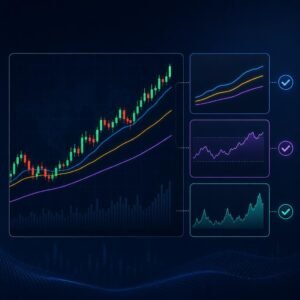
The published FintechZoom.io trading course description lists a range of topics associated with stock trading education. These include market fundamentals, candlestick patterns, price trends, day trading, swing trading, position trading, stop-loss strategies, portfolio allocation, trading psychology, and market indicators.
The description also mentions trading platforms, financial news, options, forex, margin trading, and algorithmic trading. These topics vary considerably in complexity and risk. A good beginner’s learning path should establish a foundation in ordinary shares, market orders, risk management, and financial analysis before introducing leveraged or derivative products.
The investing course description covers a different set of topics, including risk and return, compounding, equities, bonds, mutual funds, exchange-traded funds, asset allocation, value investing, dividend strategies, and portfolio diversification.
These published topic lists provide a useful framework for understanding what the website says it offers. They should not be treated as independent confirmation of the course’s quality, teaching methods, instructor credentials, or learning outcomes.
7. Technical Analysis and Stock Charts
Technical analysis is the study of historical prices, trading volume, and chart patterns to assess market behavior. Traders use it to identify potential entry and exit points, evaluate momentum, and develop rules for managing positions.
A stock chart can display price movements across different time frames, such as one minute, one hour, one day, or one week. The appropriate time frame depends on the trading approach and the purpose of the analysis.
Technical analysis is not a reliable way to predict every price movement. Patterns can fail, market conditions can change suddenly, and unexpected announcements can invalidate a previously reasonable trading setup.
Understanding Candlestick Patterns
Candlestick charts show the opening price, closing price, highest price, and lowest price for a selected period. The body represents the difference between the opening and closing prices, while the wicks show the high and low.
Common patterns include doji candles, hammer candles, engulfing patterns, and shooting stars. Traders sometimes interpret these formations as signs of indecision, potential reversals, or changes in buying and selling pressure. A pattern alone does not establish that a trade is likely to succeed.
Support, Resistance, and Trend Analysis
Support refers to a price area where buying interest has previously slowed or interrupted a decline. Resistance refers to an area where selling pressure has previously limited an advance. These are zones rather than guaranteed barriers.
Trend analysis involves studying whether prices are generally moving upward, downward, or sideways. Learners can also study moving averages, relative strength index (RSI), and moving average convergence divergence (MACD). Indicators should support a defined analytical process rather than replace judgment or risk controls.
8. Fundamental Analysis of Stocks
Fundamental analysis evaluates a company’s business performance and financial position to estimate its underlying value. It may involve examining revenue growth, profitability, debt, cash flow, competitive advantages, industry conditions, and management decisions.
Unlike technical analysis, which primarily examines price and volume data, fundamental analysis focuses on the business behind a stock. Long-term investors often use it to compare companies and determine whether their market valuations appear reasonable relative to their prospects.
Financial Statements and Company Performance
The three major financial statements are the income statement, balance sheet, and cash flow statement. The income statement reports revenue, expenses, and profit over a period. The balance sheet presents assets, liabilities, and shareholders’ equity at a particular date. The cash flow statement explains how cash enters and leaves the business.
Investors may examine earnings per share, operating margins, free cash flow, return on equity, and debt levels. These metrics should be interpreted in context because different industries have different business models and financial characteristics.
Understanding the Price-to-Earnings Ratio
The price-to-earnings ratio, commonly called the P/E ratio, compares a company’s share price with its earnings per share. It can help investors compare valuations, but it should not be used in isolation.
A high P/E ratio may reflect strong growth expectations, while a low ratio may reflect weak prospects, financial concerns, or a market that has overlooked the company’s potential. Comparisons are generally more meaningful when the businesses have similar characteristics.
9. Risk Management in Stock Trading
Risk management is one of the most important subjects in stock market education. Every trading strategy involves uncertainty, and even a carefully researched position can lose money. The objective of risk management is to control exposure and avoid allowing one mistake to cause disproportionate financial damage.
One principle is to avoid risking money needed for essential expenses, debt payments, emergencies, or near-term financial commitments. Speculative trading should never be confused with a reliable method of paying household bills.
Traders may establish position-sizing rules, define the amount they are prepared to lose on a trade, and use stop-loss orders where appropriate. A stop-loss order does not guarantee a particular exit price, especially during market gaps or periods of poor liquidity.
Diversification can also help reduce the impact of a single company or sector on a portfolio. However, diversification cannot eliminate market risk, and holdings that appear different may still fall together during periods of broad market stress.
10. Common Stock Trading Strategies
A stock market course may introduce several trading styles. These approaches differ in holding period, decision-making frequency, transaction costs, and exposure to market movements. Beginners should understand these differences before deciding whether active trading fits their circumstances.
Day Trading
Day trading involves opening and closing positions within the same trading day. Traders may study intraday charts, price movements, liquidity, volume, and scheduled economic announcements.
This approach can require significant time, discipline, and experience. Frequent trading may also increase transaction costs and make emotional decisions more likely. Day trading is not a guaranteed way to generate income.
Swing Trading
Swing trading generally involves holding positions for several days or weeks while attempting to benefit from price movements over that period. Traders may combine technical analysis with company news and broader market conditions.
Positions remain exposed to overnight price changes, unexpected announcements, and market gaps. A strategy that looks attractive on a chart may still produce a loss when actual market conditions differ from expectations.
Position Trading
Position trading involves holding positions for a longer period, potentially weeks or months. Participants may focus on broader trends, economic developments, and major price levels.
Although the trading frequency may be lower than in day trading, position traders still need to understand risk, changing market conditions, and the possibility of sustained losses.
11. Investing vs. Trading: What Is the Difference?
Investing and trading both involve financial markets, but they often have different objectives. Long-term investing generally focuses on building wealth over years through asset ownership, business growth, reinvested returns, and portfolio management. Trading usually focuses on taking positions based on shorter-term or medium-term opportunities.
Long-term investors may prioritize company fundamentals, investment costs, diversification, and their personal financial goals. Active traders may pay more attention to price patterns, liquidity, momentum, and specific entry and exit rules.
Neither approach is automatically better for every individual. The right choice depends on time availability, financial circumstances, investment horizon, risk tolerance, and personal knowledge.
People seeking retirement savings or long-term financial security should learn about diversified investments, fees, taxes, and asset allocation before assuming that active trading is necessary. A sound financial education explains the strengths and limitations of both approaches instead of promoting one as universally superior.
12. Portfolio Management and Diversification
A portfolio is the collection of investments owned by an individual or institution. Portfolio management involves choosing assets, deciding how much to allocate to each one, monitoring performance, and making adjustments as financial goals or circumstances change.
Asset allocation describes how a portfolio is distributed among categories such as stocks, bonds, cash, and other investments. An appropriate allocation depends on factors including time horizon, financial needs, income stability, and risk tolerance.
Diversification means spreading exposure across different investments rather than depending on one company or asset. It may involve different industries, company sizes, regions, or asset classes. Holding several stocks from the same sector may provide less diversification than it first appears.
Portfolio rebalancing involves bringing allocations back toward a chosen plan after market movements change their proportions. Rebalancing can help maintain a consistent risk profile, but fees, taxes, and personal circumstances should be considered before making changes.
13. Market News and Economic Indicators
Stock prices can respond to corporate earnings, inflation reports, interest-rate decisions, employment data, geopolitical developments, and changes in consumer demand. Learning how to interpret these events can help investors understand why prices move.
Economic indicators provide information about the condition of an economy. Inflation measures changes in prices, while employment reports provide insight into the labor market. Central bank decisions can influence borrowing costs, valuations, and expectations about economic growth.
Company-specific news also matters. Earnings announcements, product launches, regulatory decisions, acquisitions, and management changes may influence how investors evaluate a business.
Financial news should be treated as information to assess, not an automatic instruction to buy or sell. Market prices may already reflect widely anticipated information, and an apparently positive announcement can sometimes be followed by a price decline if expectations were even higher.
14. Trading Psychology and Emotional Discipline
Trading psychology examines how emotions and cognitive biases influence financial decisions. Fear, greed, overconfidence, impatience, and the desire to recover previous losses can lead people to abandon a carefully considered plan.
For example, a trader might hold a losing position because admitting a mistake feels uncomfortable. Another might buy an asset after a rapid price increase because of fear of missing out. Both decisions can be influenced more by emotion than by a consistent analytical process.
A trading journal can help learners record the reasoning behind decisions, the rules they followed, and the results they observed. Reviewing this information may reveal recurring mistakes and opportunities to improve discipline.
Good financial education emphasizes that losses are part of uncertain markets. A disciplined process does not eliminate losses, but it can help prevent emotional reactions from creating additional risk.
15. Course Format and Learning Resources
The FintechZoom.io course pages describe educational resources associated with their trading and investing programs. The trading page mentions on-demand video lessons, practical resources, charts, strategy guides, quizzes, and a certificate of completion. The investing page describes video lessons, printable worksheets, quizzes, and a certificate.
These are published descriptions, not independent verification that every resource is available to every student or that the materials meet a particular educational standard. Learners should confirm the current offering directly with the provider and review the complete terms before enrolling.
Different learning formats serve different needs. Videos can introduce concepts, written lessons can provide reference material, quizzes can test understanding, and practice exercises can help learners apply ideas to realistic examples.
A useful course should explain its learning objectives and provide enough context for students to understand why a concept matters. It should also distinguish educational simulations from actual market execution and make clear that examples of profitable trades do not demonstrate that future trades will be profitable.
16. Potential Benefits of Structured Stock Market Education
Structured education can make unfamiliar financial concepts easier to understand by organizing them in a logical sequence. Instead of encountering disconnected tips, learners can progress from market fundamentals to chart reading, company analysis, risk management, and portfolio construction.
Another potential benefit is improved financial vocabulary. Understanding terms such as market capitalization, volatility, liquidity, earnings per share, and diversification can make financial reports easier to read.
Courses may also encourage learners to develop consistent research habits. These include checking the source and date of information, reviewing company disclosures, considering alternative explanations for price movements, and recording assumptions before making decisions.
However, the value of a course depends on its accuracy, clarity, teaching quality, and suitability for the learner. Structured learning is helpful, but it cannot replace independent verification or guarantee investment success.
17. Limitations and Risks of Online Trading Courses
Online courses vary significantly in quality. Some offer carefully structured lessons and transparent instructor information, while others may provide only introductory material or make claims that are difficult to verify.
A major limitation is that financial markets change continuously. A strategy discussed in an older lesson may perform differently under current market conditions, and historical examples may not represent what happens in the future.
Another limitation is the difference between theoretical knowledge and practical decision-making. Understanding a chart pattern does not automatically teach a student how to manage uncertainty, control emotions, account for transaction costs, or respond to unexpected events.
Be cautious of providers promising guaranteed returns, secret strategies, effortless profits, or a fixed income from trading. No legitimate educational program can remove market risk. Claims of guaranteed performance should be treated as a warning sign rather than a reason to enroll.
Also consider opportunity cost. Time spent learning advanced trading methods may be less useful than building an emergency fund, reducing expensive debt, or understanding diversified long-term investments, depending on your financial situation.
18. How to Evaluate a Stock Market Course Before Enrolling
Before paying for any stock market course, compare the advertised curriculum with your learning goals. A course intended for active traders may devote considerable time to chart patterns and order execution, while an investing course may focus on company valuation, diversification, and long-term planning.
Review the instructor’s name, professional background, relevant experience, and any claims of accreditation or certification. If an organization claims that a course is recognized by a professional body, verify that claim through the body itself.
Read the full pricing information. Check whether the advertised price is a one-time payment or recurring subscription, what happens when access expires, whether course updates cost extra, and how cancellation and refunds work.
Look for detailed sample lessons or a clear syllabus. Genuine educational value should be explainable without relying on promises of wealth. Independent reviews can help, but consider whether the reviewer appears to have personally completed the course and whether their statements are supported by specific evidence.
Finally, review the provider’s privacy and security practices. Avoid sending money through unusual channels or sharing sensitive financial credentials with anyone claiming to provide trading education.
19. Alternative Stock Market Learning Resources
Students who want to compare learning options can explore established online education platforms. One option is Coursera’s stock trading course directory, which lists courses and learning programs covering market analysis, technical analysis, financial statements, trading strategies, and risk management.
The directory includes options from institutions and organizations such as Yale University, the University of Geneva, the Indian School of Business, and Interactive Brokers. Availability, ratings, pricing, trial access, and course requirements can change, so review the current listing before making a choice.
For example, Yale University’s Financial Markets course introduces concepts related to financial markets and risk. The University of Geneva’s Understanding Financial Markets course addresses financial markets and portfolio management. Other listings focus more specifically on trading basics, technical analysis, or investment strategies.
These options illustrate why comparing the curriculum is important. A course designed to explain how markets work may be a better starting point for a beginner than one focused on complex trading techniques. A course with a certificate may be useful for demonstrating completion, but its recognition depends on the issuing organization and the purpose for which the credential is being used.
20. A Beginner’s Roadmap to Learning the Stock Market
Beginners can benefit from a step-by-step plan that starts with basic concepts and gradually introduces more demanding topics. The following sequence provides a practical framework regardless of which educational platform you choose.
Step One: Learn Financial Fundamentals
Start with shares, stock exchanges, market indices, dividends, brokerage accounts, and order types. Understand how stock prices change and why a company’s share price does not necessarily reflect the full value of its business.
Step Two: Study Investment Risk
Learn about volatility, market risk, liquidity risk, diversification, and the possibility of losing some or all of the money invested. Understand why emergency savings and essential living expenses should be separated from speculative trading capital.
Step Three: Compare Fundamental and Technical Analysis
Learn how to read a company’s financial statements and assess basic valuation metrics. Then explore chart patterns, price trends, trading volume, and technical indicators. Understand that both methods have limitations and neither can predict future prices with certainty.
Step Four: Practice Without Real Money
Use a paper-trading account or spreadsheet to record hypothetical decisions. Track the entry price, exit price, reason for the trade, potential risk, and result. This helps you practice a repeatable process without immediately exposing real savings to market losses.
Step Five: Review and Continue Learning
Evaluate what you understand well and where you need more practice. Revisit concepts that remain unclear, compare educational sources, and avoid moving to advanced products simply because they appear exciting or promise larger returns.
21. A Practical Stock Market Practice Plan
A structured practice routine can help reinforce what you learn. You do not need to monitor prices throughout the day to develop basic financial literacy. Consistency and careful observation are often more useful than constant exposure to market noise.
During the first week, focus on financial terminology, the purpose of stock exchanges, and the difference between shares and other investment products. Write a short explanation of each concept in your own words.
During the second week, select a publicly traded company and examine its publicly available business information. Review its revenue, earnings, debt, and recent announcements. Compare the current share price with the company’s historical performance without assuming that past returns will continue.
During the third week, study a stock chart and identify a trend, a possible support zone, and a possible resistance zone. Record your observations before looking at subsequent price movements. This helps demonstrate how often a technical interpretation can be uncertain.
During the fourth week, create a hypothetical portfolio and track its performance. Record how different investments respond to market developments and consider how diversification changes the overall result. Include hypothetical transaction costs where appropriate.
At the end of the month, review your notes and identify the concepts you still find difficult. The objective is not to prove that you can predict prices. It is to build a stronger understanding of financial markets, risk, and disciplined decision-making.
22. Common Mistakes Beginner Traders Should Avoid
One common mistake is entering the market before understanding basic terminology or how orders work. Beginners may also follow social media recommendations without investigating the company, the source of the claim, or the risks involved.
Another mistake is confusing a rising stock price with a fundamentally strong business. Prices can rise for many reasons, and a company with an attractive product can still be an expensive investment. Conversely, a low share price does not automatically mean that a stock is undervalued.
Using borrowed money or margin without understanding the consequences can increase losses. Leveraged positions may lose value quickly, and investors can face additional obligations depending on the product and account terms.
Some learners also change strategies after a small number of unsuccessful trades. A better approach is to evaluate assumptions carefully, account for costs, and understand the limits of a small sample of results before drawing conclusions.
Finally, avoid treating a course completion certificate as proof of trading skill. Knowledge must be applied carefully, and experience does not eliminate uncertainty or guarantee positive returns.
23. Is the FintechZoom.io Stock Market Course Worth Considering?
Whether a course is worth considering depends on its verified identity, actual curriculum, teaching quality, cost, and suitability for your objectives. The published FintechZoom.io course descriptions mention topics that are relevant to stock market education, including technical analysis, market fundamentals, trading psychology, portfolio allocation, and risk management.
Those topics can form part of a useful financial education program. However, the presence of relevant topics on a website does not establish that the course is trustworthy, accredited, comprehensive, or worth its advertised price.
The affiliation warning published by FintechZoom.com is an especially important consideration. Because that website says fintechzoom.io is not affiliated with its platform, readers should independently verify the identity of the .io course provider and should not assume that the two domains represent the same organization.
If your main objective is to learn stock market fundamentals, compare the published curriculum with established alternatives, including courses available through Coursera. Consider starting with a beginner-level financial markets course before studying advanced trading techniques.
Ultimately, a good course should improve your understanding of financial decisions, explain risks honestly, and help you think critically. It should not promise a guaranteed income or suggest that a short program can eliminate the uncertainty inherent in financial markets.
24. Key Takeaways About the FintechZoom.io Stock Market Course
- The search term refers to interest in online stock market trading and investment education associated with FintechZoom.io.
- The published course pages describe trading and investing programs with different learning objectives.
- Relevant topics include stock market basics, technical analysis, fundamental analysis, trading strategies, portfolio management, and risk control.
- FintechZoom.com has published an explicit warning that it is not affiliated with fintechzoom.io, so provider identity should be checked carefully.
- Course descriptions alone cannot verify teaching quality, accreditation, current pricing, or student outcomes.
- Coursera offers alternative financial markets and stock trading courses from various institutions and organizations.
- Paper trading and structured study can help beginners practice without immediately risking real money.
- No stock market course can guarantee investment profits or eliminate the possibility of losses.
25. Frequently Asked Questions
What is the FintechZoom.io stock market course?
It is a search term associated with stock market learning resources and the trading and investing course descriptions published on FintechZoom.io. The published material discusses topics such as market fundamentals, trading strategies, financial analysis, risk management, and portfolio construction. Verify the provider and current course terms independently before enrolling.
Is FintechZoom.io affiliated with FintechZoom.com?
FintechZoom.com has published a warning stating that fintechzoom.io is not affiliated with its platform. Readers should review the published domain warning and avoid assuming that similarly named websites share ownership or authorization.
Is the course suitable for beginners?
The published trading course description says it is intended for new traders as well as intermediate learners and working professionals. However, suitability depends on the actual lessons and the student’s prior knowledge. Beginners should confirm the syllabus and look for clear explanations of basic market concepts and investment risk.
What topics should a stock market course teach?
A comprehensive introductory course should cover stock market fundamentals, trading terminology, financial statements, basic valuation, technical analysis, market news, risk management, diversification, and trading psychology. Advanced topics such as options, futures, margin, and algorithmic trading are best approached after learners understand the fundamentals.
Does a stock market course guarantee profits?
No. Stock prices can rise or fall unexpectedly, and even experienced market participants experience losses. Educational programs can explain analytical methods and risk controls, but they cannot guarantee profitable results.
Does the FintechZoom.io course provide a certificate?
The published course descriptions mention a certificate of completion. Before paying, confirm that the certificate is currently offered, what requirements must be completed to receive it, and which organization issues it. A certificate of completion does not automatically represent a professional license or an accredited qualification.
How long does the course take to complete?
The published trading course description mentions approximately four to six hours of on-demand video lessons, while the investing course description mentions approximately seven to eight hours. These figures should be verified against the current course information. Your total study time may be longer if you complete exercises, take notes, or practice with market data.
Can I learn stock trading for free?
Yes. Beginners can start with free financial education resources, public company reports, educational articles, and selected online courses. Coursera’s course directory includes some learning options marked free, although access conditions and certificate fees may vary. Always check the current enrollment details.
What is the difference between stock trading and stock investing?
Trading generally focuses on buying and selling securities over shorter or medium periods according to a strategy. Investing often focuses on long-term ownership, financial goals, asset allocation, and portfolio growth. Both involve risk, and the appropriate approach depends on personal circumstances.
What is technical analysis?
Technical analysis studies historical price movements, trading volume, chart patterns, and indicators. It can help traders organize observations and develop trading rules, but it cannot predict future prices with certainty.
What is fundamental analysis?
Fundamental analysis evaluates a company’s financial performance, business model, competitive position, and valuation. Investors may examine revenue, earnings, cash flow, debt, and valuation ratios to understand a company’s financial condition and prospects.
Is paper trading useful for beginners?
Paper trading lets learners simulate buying and selling without risking real capital. It can help them practice order placement, record decisions, and understand trading mechanics. However, simulated results may not reflect real transaction costs, execution conditions, or the emotional pressure of actual financial losses.
Which alternative courses should beginners compare?
Beginners can review courses such as Yale University’s Financial Markets, the University of Geneva’s Understanding Financial Markets, and Trading Basics from the Indian School of Business through the Coursera stock trading directory. Compare course content, prerequisites, fees, and the type of certificate offered before choosing.
How can I identify an unreliable stock trading course?
Be cautious of guaranteed-return promises, pressure to pay immediately, unclear instructor identities, unverifiable credentials, missing refund terms, and requests for sensitive financial credentials. A reliable educational provider should explain what it teaches and acknowledge that investing and trading involve risk.
Can learning stock trading help my career?
Financial market knowledge can be relevant to careers in finance, research, investment operations, and related fields. However, career requirements vary by role and jurisdiction. A short online course alone may not satisfy the education, licensing, or experience requirements for a professional financial position.
Conclusion: Build Your Stock Market Knowledge Carefully
The FintechZoom.io stock market course is associated with published descriptions of online trading and investing education covering topics that matter to beginners and intermediate learners. Understanding market fundamentals, technical and fundamental analysis, portfolio management, and risk control can provide a useful foundation for making informed financial decisions.
Before enrolling, however, verify the provider’s identity, review the course terms, and compare its content with established educational alternatives. The warning published by FintechZoom.com about its lack of affiliation with fintechzoom.io makes this verification particularly important.
Start with financial literacy, learn how markets operate, and practice analyzing information before risking real money. The purpose of stock market education should be to improve your knowledge, critical thinking, and understanding of risk—not to promise quick wealth or guaranteed profits.
Financial disclaimer: This article is for general educational and informational purposes only. It is not personalized financial, investment, tax, or legal advice. All investing involves risk, including the possible loss of capital. Conduct independent research and consult a qualified professional where appropriate before making financial decisions.
Related Articles
For more details about Target Corporation, its official website, and its online services, visit the Target company URL to find the information you need.