
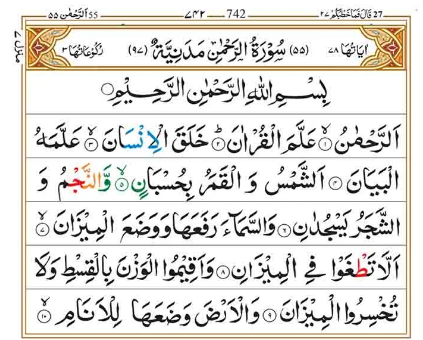
Surah Rahman is one of the most beautiful and memorable chapters of the Quran. It is the 55th surah of the Quran and contains 78 verses. Its name comes from the opening word, Ar-Rahman, meaning “The Most Compassionate” or “The Beneficent.” The surah reminds people of Allah’s mercy, His gifts, His power over creation, and the life that comes after death.
One feature makes Surah Rahman stand out: the repeated question, “So which of your Lord’s favors will you both deny?” This question appears throughout the chapter. It asks both humans and jinn to think about the many blessings they receive from Allah. These blessings include the Quran, human life, speech, the sun, the moon, the earth, food, water, justice, and the rewards of Paradise.
Surah Rahman also presents a balanced picture of life. It speaks about mercy and blessings, but it also reminds people about accountability and the Day of Judgment. The chapter moves from signs in creation to warnings about judgment and then to descriptions of Paradise.
For Muslims, reading Surah Rahman can be a time for reflection, gratitude, worship, and remembrance of Allah. Its repeated verses also make its central message easy to remember.
What Is Surah Rahman?
Surah Rahman is the 55th chapter of the Quran. It has 78 ayahs, or verses, and is found in Juz 27. Quran.com lists it under the title “The Beneficent” and provides its Arabic text, translations, recitations, and tafsir.
The chapter begins with a single powerful word:
Ar-Rahman — The Most Compassionate.
It then immediately mentions one of Allah’s greatest gifts: teaching the Quran.
This order is meaningful. Before mentioning many physical blessings, the surah points to guidance from Allah. It then mentions the creation of humanity and the ability to communicate.
Basic facts about Surah Rahman
| Detail | Information |
|---|---|
| Surah number | 55 |
| Name | Ar-Rahman |
| Common English meaning | The Most Compassionate / The Beneficent |
| Number of verses | 78 |
| Juz | 27 |
| Opening word | Ar-Rahman |
| Main language | Arabic |
| Main subjects | Mercy, creation, blessings, accountability, Paradise and Allah’s greatness |
| Repeated question | Which of your Lord’s favors will you deny? |
| Final verse | 55:78 |
There is some discussion among scholars about the place and period of revelation. The majority view presented in traditional tafsir sources is that Surah Rahman is Makki, although reports and scholarly discussions have differed on this point. Quran.com notes that commentators generally consider it a Makki surah while also recording views that place it in Madinah.
Why Is Surah Rahman Called Ar-Rahman?
The name Ar-Rahman comes from the first verse. The word refers to Allah as the Most Compassionate or Most Merciful in a broad sense.
The opening is:
“Ar-Rahman.”
The next verses explain some of the ways Allah’s mercy is shown:
- He taught the Quran.
- He created humanity.
- He taught people expression and speech.
- He created the sun and moon with order.
- He created plants and trees.
- He raised the sky and set the balance.
- He created the earth and its provisions.
The chapter therefore connects Allah’s mercy with both spiritual and physical blessings.
The name is not simply a title. It prepares the reader for the main message of the chapter. Again and again, Surah Rahman asks people to recognize the favors around them.
Surah Rahman and the Message of Allah’s Mercy
Mercy is at the heart of Surah Rahman.
The chapter does not present mercy as an abstract idea. Instead, it points to things people can see and use every day.
A person can breathe, speak, eat, drink, learn, work, think, and communicate. The world contains systems that support life. The Quran asks readers to notice these gifts rather than treating them as ordinary.
The first group of verses gives a striking order:
- Allah is Ar-Rahman.
- Allah taught the Quran.
- Allah created humanity.
- Allah taught humanity expression.
- Allah created the sun and moon.
- Allah created plants and trees.
- Allah established balance.
This order encourages gratitude. It also reminds readers that knowledge and guidance are among Allah’s gifts.
Surah Rahman and the Repeated Question
The most recognizable feature of Surah Rahman is the repeated verse:
“So which of your Lord’s favors will you both deny?”
The Arabic wording is:
فَبِأَيِّ آلَاءِ رَبِّكُمَا تُكَذِّبَانِ
This verse appears many times in the surah and creates a strong rhythm.
The word “both” is important because the verse addresses both humans and jinn. Traditional tafsir discusses this direct address to the two groups. Ibn Kathir also records a narration concerning the Prophet Muhammad ﷺ reciting the surah and the response associated with this repeated verse.
The repeated question can make a reader stop and think:
- What blessings have I received?
- Do I recognize them?
- Do I show gratitude?
- Am I using my abilities in a good way?
- Do I remember the One who gave me these gifts?
Rather than being a question that needs only a spoken answer, it encourages personal reflection.
Major Themes in Surah Rahman
Surah Rahman covers several connected themes. Each one supports the main message of recognizing Allah’s mercy and power.
Allah’s mercy
The surah begins with Ar-Rahman. This places divine mercy at the front of the chapter.
The gift of the Quran
The Quran is mentioned immediately after the name Ar-Rahman. This shows the importance of guidance as a blessing.
Human creation
The surah reminds people that their existence is itself a gift.
Speech and communication
Allah is described as teaching humanity expression. Human language, thought, and communication are presented as blessings.
Order in creation
The sun, moon, stars, plants, trees, earth, and sky are mentioned as signs of Allah’s power and order.
Balance and justice
The surah refers to the balance and warns people not to transgress that balance.
Human dependence
People may feel independent, but Surah Rahman repeatedly directs attention toward the One who provides life and its resources.
The Day of Judgment
The chapter warns that creation is not without accountability.
Paradise
Later passages describe gardens, springs, fruits, beautiful surroundings, and other rewards for those who fear their Lord.
Surah Rahman Verses About Creation
One of the strongest sections of Surah Rahman is its description of creation.
The chapter refers to the sun and moon moving according to an ordered system. It also mentions plants and trees, the sky, the earth, and the balance.
These verses direct attention toward the natural world.
A reader can look at the changing day and night, the movement of celestial bodies, plants growing from the earth, and the many forms of food available to humanity. The surah uses such signs to encourage awareness of Allah.
This is not simply a scientific lesson. The purpose is spiritual reflection.
The natural world becomes a reminder of the Creator.
The idea of balance
Surah Rahman refers to the mizan, commonly translated as balance or scale.
The chapter warns people not to transgress the balance.
This idea can be understood in more than one way. It relates to the order Allah has placed in creation and also carries a moral lesson about fairness and proper conduct.
A person should not abuse what Allah has provided.
That message has practical meaning in everyday life. People should act fairly, avoid wrongdoing, and recognize that their actions have consequences.
Surah Rahman and Human Responsibility
The surah does not only tell people to be thankful. It also reminds them that blessings come with responsibility.
Surah Rahman therefore connects blessings with accountability.
The repeated question encourages a person to ask not only, “What has Allah given me?” but also, “How am I using what I have been given?”
Surah Rahman and the Two Groups: Humans and Jinn
One distinctive part of Surah Rahman is its direct address to humans and jinn.
The repeated verse uses the plural form connected with the two groups. The message is therefore not limited to human beings.
Both humans and jinn are reminded of Allah’s signs, favors, power, judgment, and rewards.
This broad audience gives the surah a universal quality within Islamic belief.
Why the repeated address matters
The reader is repeatedly brought back to the same question.
The rhythm can be understood as a call to pause.
After mentioning one blessing, the surah asks:
What favor could you deny?
After describing another sign, the question returns.
The effect is powerful because the list of blessings becomes difficult to ignore.
Surah Rahman and the Day of Judgment
Surah Rahman also speaks about the future.
After describing creation and blessings, the surah turns toward accountability. The Quran teaches that earthly life is not the end.
Human beings will face Allah.
The chapter includes warnings about those who reject the truth and descriptions of the consequences that follow.
This section creates balance within the surah. Allah’s mercy is not separated from justice.
A person should hope in Allah’s mercy while also taking responsibility for faith and actions.
Surah Rahman and Paradise
A large part of the later section of Surah Rahman describes Paradise.
The Quran describes gardens, springs, fruits, palms, and other beautiful blessings. It also describes people receiving rewards from their Lord.
The descriptions are meant to create hope.
They also remind believers that the blessings of this world are temporary, while the rewards promised by Allah are connected with the Hereafter.
The two pairs of gardens
The surah describes two gardens and later mentions two more gardens.
The passages include images of:
- flowing or abundant springs
- fruits
- date palms
- pomegranates
- beautiful surroundings
- shade
- comfort
- honored believers
The repeated question appears between many of these descriptions.
This keeps the reader focused on gratitude even while hearing about future rewards.
Fruits mentioned in Surah Rahman
Among the foods mentioned are fruits, dates, and pomegranates.
These familiar foods are presented as examples of Allah’s provision.
The lesson is simple: blessings should not be taken for granted.
Surah Rahman and Gratitude
Gratitude is one of the strongest lessons of the chapter.
The repeated question encourages readers to recognize favors instead of ignoring them.
Gratitude in Islam is not limited to saying “thank you.” It can include:
- recognizing Allah as the source of blessings
- using blessings responsibly
- obeying Allah
- helping others
- avoiding waste
- speaking truthfully
- remembering Allah regularly
A person who thinks about Surah Rahman may begin noticing ordinary blessings in a new way.
Water becomes a reminder.
Food becomes a reminder.
Family becomes a reminder.
Knowledge becomes a reminder.
The ability to communicate becomes a reminder.
Health and time become reminders.
The chapter trains the heart to notice.
A Simple Breakdown of Surah Rahman
The 78 verses can be understood through several broad sections.
| Verses | Main subject | Central idea |
|---|---|---|
| 1–13 | Allah’s mercy and creation | Recognize Allah’s blessings |
| 14–25 | Creation and the natural world | Allah has power over creation |
| 26–30 | Human mortality and dependence | Everything depends on Allah |
| 31–45 | Accountability and judgment | Human actions have consequences |
| 46–61 | Rewards for the righteous | Paradise is a promised reward |
| 62–77 | Additional descriptions of Paradise | More blessings for the faithful |
| 78 | Closing praise | Allah has majesty and honor |
This structure is a helpful way to understand the flow of the surah without treating each section as separate from the others.
The Meaning of the Opening Verses
The opening verses are short but carry a deep message.
Allah is introduced as Ar-Rahman.
Then comes:
- teaching the Quran
- creating humanity
- teaching expression
- creating the sun and moon
- creating vegetation
- establishing balance
This sequence links mercy with guidance, creation, and order.
It tells the reader that Allah’s favors are not limited to material things.
The Quran itself is described as a gift.
That is an important lesson for anyone who wants to understand the purpose of revelation.
What Does Surah Rahman Teach About the Quran?
The second verse states that Ar-Rahman taught the Quran.
This is striking because the Quran is mentioned before human creation in the opening sequence.
The message suggests that guidance has a central place in human life.
People need food and water, but they also need guidance about how to live.
The Quran teaches belief, worship, morality, responsibility, patience, justice, and the purpose of life.
Surah Rahman therefore encourages readers to see the Quran itself as one of Allah’s greatest favors.
The Beauty of Surah Rahman’s Style
Surah Rahman has a strong literary rhythm.
The repeated question creates a pattern that stays in the mind.
The chapter also moves between different subjects:
- creation
- blessings
- warnings
- judgment
- Paradise
- gratitude
This movement keeps the central message alive.
The same question returns after different examples, almost like a repeated call for reflection.
This is one reason Surah Rahman is widely recognized for its memorable style.
Reading Surah Rahman for Reflection
There is a difference between reading quickly and reading reflectively.
A person can read Surah Rahman and focus only on finishing the chapter.
Another person can read it slowly and think about each group of verses.
For reflection, a simple method is useful.
Read the Arabic
Begin by reading the Arabic carefully if you can.
Read a trusted translation
A translation can help readers understand the general meaning.
Read a reliable tafsir
Tafsir provides context and scholarly explanation.
Pause at the repeated verse
When the repeated question appears, stop for a moment.
Ask yourself what blessing has just been mentioned.
Connect the message with daily life
Think about how the verse relates to your own actions and gratitude.
This method can turn Quran reading into a more thoughtful experience.
Surah Rahman Benefits: What Can Readers Gain?
People often search for Surah Rahman benefits. It is important to separate well-supported Islamic teachings from claims that are not clearly established.
Reading the Quran is an act of worship for Muslims, and reflecting on its message can support faith, gratitude, remembrance, and moral awareness.
However, claims that a specific surah guarantees a particular worldly result should not be presented as established fact unless supported by reliable evidence.
Spiritual benefits of reflection
Surah Rahman can remind a reader about:
- Allah’s mercy
- the importance of gratitude
- the temporary nature of worldly life
- the certainty of accountability
- the beauty of Paradise
- the importance of Quranic guidance
- the need to use blessings responsibly
These are clear lessons from the chapter itself.
Is There a Specific Time to Read Surah Rahman?
There is no need to restrict Quran reading to one particular time unless a reliable Islamic source establishes such a restriction.
A Muslim may read the Quran during many parts of the day according to their circumstances.
Surah Rahman can therefore be read:
- in the morning
- in the evening
- after prayer
- during personal Quran study
- during quiet reflection
- whenever a person has time for Quran reading
The important point is sincere engagement with Allah’s words rather than treating a specific time as compulsory without evidence.
Surah Rahman in Daily Life
The message of Surah Rahman can be applied to ordinary life.
Practice gratitude
Before complaining about what is missing, think about what Allah has already provided.
Protect your speech
The surah mentions Allah teaching humanity expression. This can remind us that speech is a blessing and a responsibility.
Be fair
The reference to balance gives a strong reminder about fairness.
Avoid waste
Food, water, money, time, and other resources should not be treated carelessly.
Remember the Hereafter
Worldly success is temporary. Surah Rahman directs attention toward the life after death.
Use blessings for good
Every ability can become an opportunity to help others.
Surah Rahman and the Meaning of Balance
The concept of balance deserves careful attention.
Modern life can become extreme. People may focus only on work, money, entertainment, or personal wants.
The Quranic message encourages a more responsible approach.
Balance can mean:
- worship without neglecting lawful responsibilities
- earning without greed
- eating without waste
- speaking without harming
- enjoying blessings without forgetting their Source
- seeking success without becoming arrogant
The verse about the balance therefore has a moral dimension that remains meaningful in everyday life.
Lessons from Surah Rahman for Families
Parents can use Surah Rahman as a simple starting point for Quran discussions with children.
Instead of asking children only to memorize the verses, parents can ask questions such as:
“What blessings did Allah mention?”
“Why do you think the same question is repeated?”
“What do we receive from the earth?”
“How can we show gratitude?”
“What does fairness mean?”
These questions can make Quran learning practical and memorable.
Older children can also learn about the Arabic words and compare different translations.
Lessons from Surah Rahman for Students
Students can gain several useful lessons from the chapter.
The surah places great value on knowledge and guidance.
It also teaches students to recognize that abilities are gifts.
A student may have:
- intelligence
- memory
- time
- teachers
- books
- technology
- family support
These are reasons for gratitude.
The surah can encourage students to use their abilities honestly and responsibly.
Surah Rahman and Modern Readers
Although the Quran was revealed centuries ago, its questions remain meaningful.
Surah Rahman speaks to these lasting human concerns.
Its language and context belong to the Quran, but its call to gratitude and accountability remains relevant to readers today.
Important Lessons from Surah Rahman
Here are some of the clearest lessons that can be taken from the chapter:
Allah’s mercy is vast.
The surah begins with Ar-Rahman.
The Quran is a great blessing.
It is mentioned near the beginning of the chapter.
Human life is a gift.
People are reminded of their creation.
Speech is a blessing.
Allah is described as teaching humanity expression.
Creation points toward its Creator.
The sun, moon, plants, earth, sky, and other signs are mentioned.
Blessings require gratitude.
The repeated question challenges people to recognize what they have received.
Justice matters.
The surah mentions balance and warns against crossing its limits.
Life is temporary.
The chapter reminds people that created things pass away.
Judgment is real.
The surah warns about accountability.
Paradise is a reward.
The later verses describe gardens and blessings for the righteous.
How to Memorize Surah Rahman
Surah Rahman is often memorized because of its repeated pattern and strong rhythm.
A simple memorization plan can help.
Start with a small section
Learn three to five verses at a time.
Listen to a trusted reciter
Repeated listening can help with pronunciation and rhythm.
Read while listening
Follow the Arabic text while the recitation plays.
Repeat from memory
After reading a section several times, close the Quran and try to recite it.
Review older verses
Do not only learn new verses. Review previous sections every day.
Learn the meaning
Understanding the meaning can make memorization more meaningful.
A person who knows what the verses mean may find it easier to remember their sequence.
Surah Rahman and Tafsir
Tafsir means explanation or interpretation of the Quran.
For serious study of Surah Rahman, readers should use respected tafsir works and qualified scholarship rather than relying only on social media posts or unsupported claims.
Quran.com currently provides several translation and tafsir resources alongside the Arabic text. Its Ibn Kathir material includes discussion of the surah’s Makki classification and narrations related to the Prophet’s recitation of Surah Rahman.
Different tafsir works may explain individual verses in different ways while agreeing on the main Quranic message.
When studying difficult passages, readers should check the Arabic wording, context, recognized tafsir, and reliable scholarship.
Surah Rahman Last Ayat
The final verse is 55:78:
“Blessed is the name of your Lord, Owner of Majesty and Honor.”
The Arabic verse is:
تَبَارَكَ اسْمُ رَبِّكَ ذِي الْجَلَالِ وَالْإِكْرَامِ
The ending is fitting because the chapter has spent much of its length describing Allah’s blessings, power, creation, mercy, judgment, and rewards.
It closes by praising Allah’s name and His majesty and honor.
The final verse brings the reader back to Allah after the many signs and blessings mentioned throughout the chapter.
What Makes Surah Rahman Memorable?
Several features make Surah Rahman stand out.
A powerful opening
It begins with Ar-Rahman, a name associated with Allah’s mercy.
A repeated question
The same question returns throughout the chapter.
Strong imagery
The surah describes the natural world and Paradise using vivid images.
A clear moral message
Readers are encouraged to recognize blessings and live responsibly.
A balanced presentation
The chapter includes mercy, blessings, warnings, judgment, and reward.
A memorable ending
The final verse praises Allah as the Lord of majesty and honor.
Common Misunderstandings About Surah Rahman
Many online articles make claims about Quran chapters without providing evidence.
Readers should be careful with statements such as:
- “Reading this surah guarantees wealth.”
- “Reading it at a certain hour guarantees a specific result.”
- “This surah must be read a fixed number of times for a particular worldly benefit.”
Such statements require reliable Islamic evidence.
It is safer to focus on what the Quran clearly teaches and what trustworthy scholars have explained.
The value of Surah Rahman does not depend on exaggerated claims.
Its actual message is already powerful: recognize Allah’s mercy, appreciate His blessings, accept His guidance, remember accountability, and hope for His reward.
A Practical Surah Rahman Reflection Routine
A short daily or weekly routine can help readers benefit from the chapter.
First: Read several verses in Arabic.
Second: Read the translation.
Third: Read a trusted tafsir for the section.
Fourth: Identify the blessings mentioned.
Fifth: Think about how those blessings appear in your own life.
Sixth: Ask how you can show gratitude through your actions.
Seventh: Make a sincere dua asking Allah for guidance and gratitude.
This approach keeps Quran study connected to real life.
Why Gratitude Matters in Islam
Gratitude is not simply positive thinking.
In Islam, gratitude is connected to recognizing Allah as the giver of blessings.
A grateful person does not have to pretend that every part of life is easy. Islam recognizes hardship, loss, fear, and sadness.
Instead, gratitude means remembering Allah even when life is difficult.
Surah Rahman repeatedly directs the reader toward the favors of Allah.
This creates a habit of noticing blessings without denying life’s challenges.
Surah Rahman: A Message of Mercy and Responsibility
One of the most useful ways to understand the surah is to hold two ideas together:
Mercy and responsibility.
Allah’s mercy is repeatedly shown through His gifts.
But people are also accountable for what they do with those gifts.
This prevents two extremes.
A person should not become so confident in mercy that they ignore responsibility.
At the same time, a believer should not become so focused on fear that they forget Allah’s mercy.
Surah Rahman brings both ideas into the same chapter.
How to Read Surah Rahman With Understanding
For a reader who wants more than recitation, three habits can make a difference.
Read slowly
There is no need to rush.
Think about repeated ideas
When the same question appears, consider why it has appeared after that particular blessing.
Study the context
A reliable tafsir can explain difficult verses and provide useful background.
The goal is not simply to finish the surah.
The goal is to let its message affect the heart, mind, and actions.
Final Summary: What Surah Rahman Teaches Us
Surah Rahman is a powerful chapter of the Quran centered on Allah’s mercy, blessings, creation, judgment, and reward. It contains 78 verses and begins with the name Ar-Rahman, reminding readers of Allah’s compassion.
The chapter then points to the Quran as a blessing, followed by human creation, speech, the sun, moon, plants, trees, the sky, the earth, and the balance placed within creation.
Its repeated question — “So which of your Lord’s favors will you both deny?” — encourages humans and jinn to recognize Allah’s gifts rather than ignore them.
Surah Rahman also teaches that life has a purpose. People will face accountability, and the righteous are promised beautiful rewards in Paradise. The later verses describe gardens, springs, fruits, comfort, and other blessings.
The final verse returns to praise:
“Blessed is the name of your Lord, Owner of Majesty and Honor.”
The greatest lesson is therefore simple: recognize Allah’s blessings, accept His guidance, live with gratitude, act fairly, remember the Hereafter, and turn back to Allah with humility.
For readers studying Surah Rahman, the chapter offers more than a beautiful recitation. It provides a lasting reminder that every blessing deserves recognition and that faith should shape the way a person thinks, speaks, and acts.
FAQs About Surah Rahman
What is Surah Rahman?
Surah Rahman is the 55th chapter of the Quran. It contains 78 verses and focuses on Allah’s mercy, blessings, creation, accountability, and the rewards prepared for the righteous.
What does Surah Rahman mean?
Surah Rahman is commonly translated as “The Most Compassionate” or “The Beneficent.” The name comes from its opening word, Ar-Rahman, one of Allah’s names.
How many verses are in Surah Rahman?
Surah Rahman contains 78 verses. It is the 55th surah and is located in Juz 27 of the Quran.
What is the repeated verse in Surah Rahman?
The repeated verse asks, “So which of your Lord’s favors will you both deny?” It reminds humans and jinn to recognize and appreciate Allah’s blessings.
What is the last verse of Surah Rahman?
The final verse is 55:78: “Blessed is the name of your Lord, Owner of Majesty and Honor.” It closes the surah with praise of Allah.